How can artists depict the lingering psychological aftermath of a period that stretches beyond comprehension?
‘How do you illustrate something invisible?’ the British documentary-maker Adam Curtis once wondered in an interview, reflecting on the difficulties of making tangible intangible phenomena that are at once everywhere and nowhere, such as global warming or financial markets. Of late, Bangkok’s Jim Thompson Art Center – the programming of which has, since 2003, complemented the Jim Thompson House, the tourist attraction and former home of the eponymous American spy turned missing silk baron – has been obliquely answering that question. Shortly after the Center’s move to a hulking new concrete HQ in 2021, its director declared that ‘all exhibitions going forward will have a connection to the man, the era that he lived in, or to the house’. Thus far, its ongoing Future Project series has fulfilled that remit not by staging surveys of local crafts or textiles, but by treating the Cold War – a period contemporaneous with Jim Thompson’s life, disappearance and posthumous celebrity – as a hyperobject of sorts: an event so vast it is beyond our comprehension, yet qualitatively accessible through art.
Comprising three works by four Thai talents, Uncountable Time is a compact group show less concerned with depicting the Cold War as a definite period than revealing its lingering aftermath or hangover within Thailand, its temporal echoes, psychological legacies and somatic byproducts. The net result is a local history lesson of an elliptical, crepuscular and mildly revisionist sort – something for which its curator, artist Arin Rungjang, is himself rightly acclaimed.
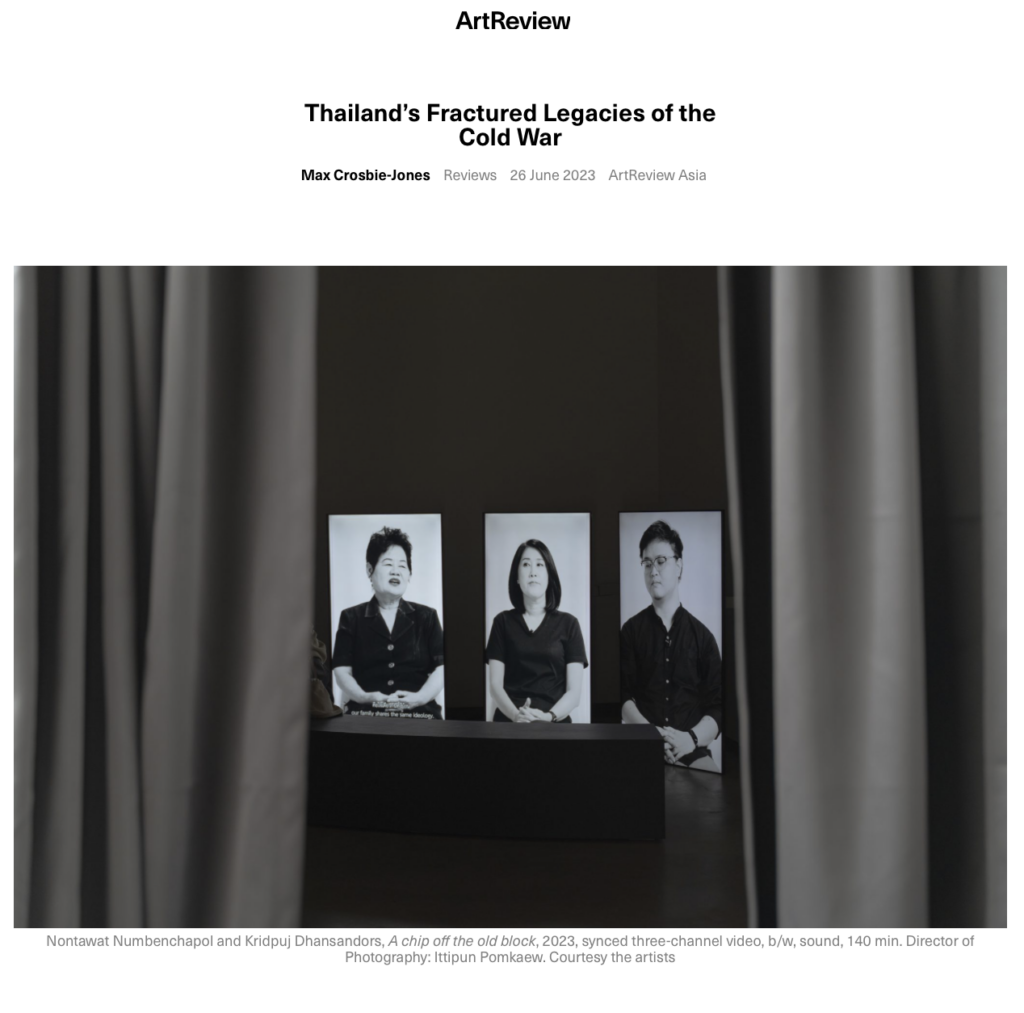
Standing out against shadowy walls, Nontawat Numbenchapol and Kridpuj Dhansandors’s three-channel video A chip off the old block (2023) is the most straightforward offering: three relatives of three different activists take turns talking about how their loved ones were politicised and subsequently persecuted (and, in the case of two of them, possibly disposed of) by the Thai state using a well-thumbed autocratic playbook. Their talking-head accounts are stark – and starker still for the harsh white background and lack of context provided. An old woman speaking is the mother of an amateur actor forced to flee the country after performing in The Wolf Bride (a one-off student play judged to have broken the country’s lèse-majesté law), for example. But while I was able to infer who’s who, those unfamiliar with Thai politics only have their tense mannerisms and the slow reveal to go on. Here, for all the forensic detail of the two-plus hours of looped testimony, communicating each family’s truth appears less important than evoking how painful cycles of far-left radicalisation and far-right intimidation – which commenced with the Thai communist insurgency of the 1960s – continue.
If this video feels at several removes from the raw emotions in play, Viriya Chotpanyavisut’s dreamy image series Another Depth (2021) counterbalances. Elsewhere these ghostly, incidental closeups of natural phenomena – a pool’s surface gently shimmering, tree branches glowering – would likely trigger entirely different responses, but here they feel like litmus tests of angsty internal states. Their pallid, acidic tone suggests that the Cold War, in the Thai context, is not a monolith over yonder or in the rearview, but a lived and living event: it shapes and distorts perceptions; it bleaches idle moments; it is still felt and acted.
The most successful work grounds such resonances in a specific place, namely a mountainous swathe of Thailand’s rural road network. In TO AND FRO (2023), Rungruang Sittirerk offers a 22-minute roadtrip centred on the recollections of his uncle, a fruit-seller who regularly travels on the far north’s Chotana Road towards Bangkok. En route there are moments of personal yearning: the episodic voiceover draws upon Sittirerk’s own sad tale of rural-to-urban migration, and a recurring motif – a man scribbling on a blank map in various locales – suggests he wishes to find a home that no longer exists. But with sections on late-twentieth-century capital inflows and infrastructure, including how Chotana Road was built during the 1950s, it is also an ambivalent excavation of ideological landscape. In northern Thailand, the Cold War era brought superhighways and supply chains, abundance and affluence, just as it blew up mountains and pulled loved ones apart. And still today it skulks above forests, blows through warehouses and orchards, winds circuitously into the future, resembling a residue or sediment layered across the land.
Uncountable Time at Jim Thompson Art Center, Bangkok, through 30 June