September 2025

SCREEN DAILY : Ray of Light to be Showcased at the TCCF Pitching Event

Taiwan Creative Content Fest (TCCF) has unveiled a bumper line-up of 94 projects to take part in its TCCF Pitching showcase, set to run November 4-7.

This year’s lineup features several cross-border adaptations of renowned IPs and international co-productions with strong market potential and international appeal, reflecting an ongoing global trend.

These include Taiwan Travelogue, a series adapted from Yang Shuang-zi’s award-winning novel of the same name; The Ones I Killed And The Ones Who Killed Me, a series adapted from Akira Higashiyama’s acclaimed novel; LOMÁ, a documentary from Berlinale Teddy award winner Huang Hui-chen; and animation A Banquet For Hungry Ghosts, adapted from Asian American food writer Ying Chang Compestine’s young adult horror story collection.

Some 56 titles will be showcased in the Project segment, including 20 feature films, 10 projects apiece for series, animations and documentaries as well as a further six series with the theme of “If Romance Comes Again”.

Scroll down for feature film Project titles

Among the highlights from the Project segment are Spent Bullets, adapted from Tetsuya Terao’s bestselling novel by Taiwanese filmmaker Henry Tsai; Goodbye My Love, Calendar Studios’ Taiwanese version of Korean drama Do It One More Time; Diary Of Summer from Japan’s Robot Communications, the production company behind Godzilla Minus One; documentary Atomic Paradise, headed by Sally Aitken, a two-time Emmy nominee; and drama series Second Woman, winner of both the FriDay Video Original Story Award and TVBS Storytelling Impact Grant Award in the Story to Screen segment of TCCF in 2023.

Several titles from the Project segment have also made it into this year’s Golden Horse Film Project Promotion, including two series (Taiwan Travelogueand The Ones I Killed And The Ones Who Killed Me) and four feature films (Burning Blossoms, Spent Bullets, Soul Lantern and Spring’s Grocery).

A further 38 projects of original published texts will be presented for IP adaptations in the Story segment.

Highlights include A Sketch Of A Female Serial Killer: Taiwan’s Only Female Death Row Prisoner And The Murders That Shocked a Nation, winner of the Taipei International Book Exhibition Grand Prize in the non-fiction category; Bodacious! Archdemons and Lifesaver Deployed, both of which are also selected for the upcoming Busan Story Market; and The Taste Of Brown Sugar, winner of the 2025 Taipei International Book Exhibition Grand Prize in the children’s book and young adult novels category.

TCCF Pitching received nearly 700 submissions from 44 countries this year and is set to be held at Taipei Nangang Exhibition Center. Aside from Taiwan, the top submitting countries were Japan, Thailand, the US, South Korea and Singapore. International submissions and co-productions involving Taiwan accounted for 60% of the entries, underscoring TCCF’s growing recognition on the global stage and a trend of cross-border collaboration in the content industry.

TCCF Pitching Project titles (feature films)

Burning Blossoms (Tai-Japan)
EP. Hitoshi Endo
Pro. Nobu Awata
Wri. Su I-Hsuan
Prodco. Suz Creative Studio

Diary Of Summer (Japan)
Dir. Remi Noda
Pro. Yusuke Yagi
Wri. Remi Noda
Prodco. Robot Communications

Fortune Seekers (Thai)
Dir. Yanyong Kuruangkura
EP./Pro. Nakarin Narkpreecha
Wri. Ploibutsara Phattrapornphisit
Prodco. Bebrave Entertainment Hub

Game Never Over (Tai)
Dir. Sean Chuang
EPs. Stefano Centini, Chang Chuti
Pro. Hung Sung-Ju
Wri. Ho Shing-Ming
Prodco. Volos Films

Goodbye My Love (Tai)
Dir. Yin Chen-Hao
EP./Pro. Jin Pai-Lunn
Wri. Ryan Tu
Prodco. Calendar Studios

Kamol (Thai)
Pro. Supatcha Thipsena
Wri. Chartchai Ketnust, Kong Pahurak
Prodco. White Light Studio

Love Letters From Tomorrow (Tai-Japan-S Kor)
EP. Peter Choe
Pros. Hsieh Yi-Lin, Ianne Cha
Wri. Yossef K. & Orign Pictures, Anne Wang
Prodco. Yoosonn Entertainment, Blintn

Midnight Express (Japan-HK-Thai-Malay-India-Uzbek-Turk-Greece-It-Fr-Sp-Port)
EP. Yamaguchi Shin
Pros. Abe Yoko, Sekiguchi Mio
Wri. Uchida Eiji, Mineo Kento
Prodco. Knockonwood

Mother Tongue (Japan-Tai)
Dir./Wri. Fu Tien-Yu
EP. Shinji Ogawa
Pro. Shoko Miyamori
Prodco. Bridgehead Co.

Mother’s Neck (Sing-Tai)
Dir. Yc Tom Lee
EPs. Jordan Lim, Charlyn Ng
Prod. Charlyn Ng
Wri. Nicholas Wang
Prodco. Juo Studios, Kusu Films

Naked In Glendale (US-China)
Pros. Jane Zheng, Julia Xu
Wri. Haohao Yan
Prodcos. Seesaw Productions, Q&A Entertainment

One Fine Day (Malay-Tai)
Dir. Tan Seng Kiat
EP. Sylvia Chang
Pros. Elyce Chin, Lim Shu Jia, E.N. Lee
Wri. Leong Siew Hong
Prodcos. One Fine Day Production House, Sunshine And Moonlight

Pivot (Tai-Turk-Ger-Serb)
Dir. Melisa Önel
Pros. Alara Hamamcıoğlu, Wesley Ko
Wri. Feride Çiçekoğlu
Prodcos. Awesomework S Production, Vigo Film, Aniden Film, Digitalkraft, Electric Sheep

Ray Of Light (Thai-Sing)
Dir. Nontawat Numbenchapol
Pros. Awat Ratanapintha, Tan Bee Thiam, Looi Wan Ping
Wri. T. Hantaweewatana
Prodcos. Mobile Lab Project, 13 Little Pictures

Seoul Story (S Kor)
EP. Summer Noh
Pro. Mark Brazeal
Wri. Kim Taeyang
Prodco. Milkyway Cinema

Soul Lantern (Tai)
Dir. Danny Tseng
EP. Lester Hsi
Pro. Fiona Hu
Wri. Jen-Fang Wang
Prodco. D-Day Pictures

Spent Bullets (Tai-US)
Dir. Henry Tsai
Pro. Jacqueline W. Liu
Wri. Henry Tsai, Terao Tetsuya
Prodco. Each Other Films

Spring’s Grocery (Tai-Indo)
Dir. Pan Ke Yin
EPs. Janice Chua, Cora Yim
Pro. Holly Chan
Wri. Aurora Lee

Prodco. Neverland Entertainment

The Daughter (Tai-HK)
Dir./Wri. Guan Tian
Pros. Patrick Mao Huang, Vivian Bao, Ding Ningyuan
Prodco. Flash Forward Entertainment, Uluka Productions

The Ghost Has A Rifle (Indo)
Dir./Wri. Iqbal Fadly
Pros. George Timothy, Siera Tamihardja
Wri. Cecille Christophia
Prodco. Creative Goods

Screen Daily

September 2025

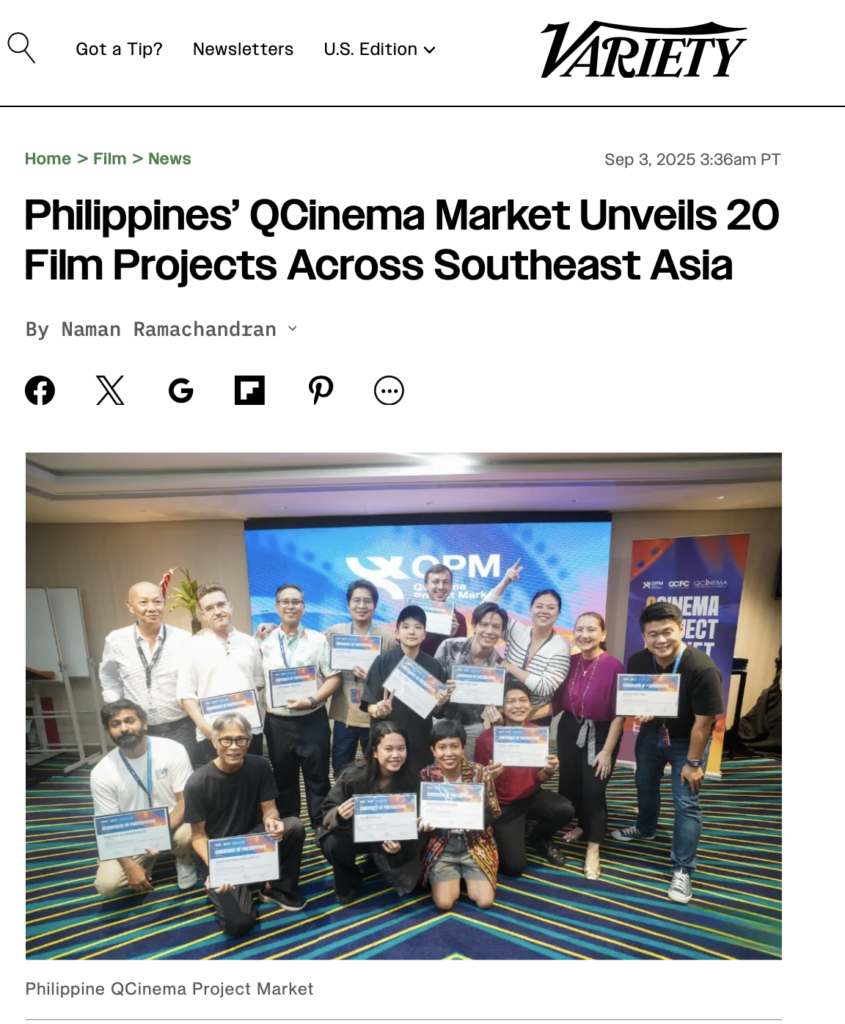
VARIETY : Ray of Light to be Showcased at the QPM

The PhilippinesQCinema Project Market (QPM), the industry wing of QCinema International Film Festival, has unveiled its lineup of 20 selected film projects for its third edition, chosen from 71 submissions across Southeast Asia.

The slate comprises 12 projects from the Philippines and eight from neighboring countries, showcasing what organizers describe as bold voices, distinctive genres, and globally resonant stories.

Several QPM alumni are already making their mark on the international circuit. Malaysian auteur Woo Ming Jin’s “The Fox King” is set to world premiere at the Toronto Film Festival this month, underscoring the market’s role as an incubator for globally competitive works. Alumni also include Dương Diệu Linh’s “Don’t Cry, Butterfly,” winner of the grand prize at Venice Critics’ Week, and Loeloe Hendra’s “Tale of the Land,” which earned the Fipresci Prize at Busan.

“QPM is not just a platform — it’s a bridge,” said QCinema industry head Liza Diño. “By connecting Southeast Asian stories to the wider world, we are giving filmmakers the visibility and access they need to secure funding, partners, and distribution.”

The regional projects span diverse genres and themes. Singapore’s “Penumbra,” directed by Russell Morton and produced by Sophia Sim and Jeremy Chua, follows a man on the run who washes up on a floating fish farm with no means of escape, where he encounters mysterious occupants. From Thailand comes Nontawat Numbenchapol’s “Ray of Light,” a class-divided story set on a present-day film set styled after 1960s glamour, where a puppet-like star actress and an unseen lighting technician form a forbidden bond.

Cambodia’s “Romdoul, the Evening Fragrance,” directed by Lomorpich Rithy, tells the intertwined story of three generations of Cambodian women in a country still haunted by war and silence. Singapore’s 11th-century period fantasy “Strange Root,” directed by Lam Li Shuen and Mark Chua, features a yam-born demigod cast aside when a shipwrecked beast reawakens islanders’ lost desires. Malaysia’s “The Willing,” from director Joon Goh, follows an Indonesian migrant teen forced into underground fights and a schoolgirl trapped by her volatile mother who find sanctuary in each other.

Thailand’s “Ghost of the Currents,” directed by Patiparn Boontarig, centers on a man returning to his Mekong riverside village after a devastating flood, where villagers blame a vengeful River Ghost for the disaster. Vietnam’s “The River Knows Our Names,” directed by Mai Huyền Chi, explores life on the undocumented floating homes of the Mekong through a little girl’s birthday wish. Myanmar’s “When the World is Paused,” from director Han Thit Htoo Aung, spans from 2019 to 2025 as Than Sin falls into a coma before confessing his feelings to Nyein and must find her upon waking.

The Philippine slate showcases the country’s filmmaking diversity. Glenn Barit’s “Luzonensis and Floresiensis” presents two prehistoric hominids from the Philippines and Indonesia meeting as migrant workers in the land of colonizers. Jaime Pacena II’s “Ozzy and Onie” follows two star-crossed lovers in 1996 Manila torn between faith, family, and a collapsing system. Carl Joseph E. Papa’s “Sentinel” connects five lives grappling with fears and loyalties as a student newspaper article threatens to expose dark school secrets.

Jopy Arnaldo’s “KomiXXX” pairs two Filipinos on break from their Japanese film — an aspiring director and a “sexy” actress wanting to star in “serious” films — who come together to make an erotic comic. Sam Manacsa’s “The Void is Immense in Idle Hours” follows 19-year-old Rosemary, the only witness to a young boy’s disappearance, as she’s drawn into the search by the child’s desperate mother Agnes.

Tyrone Acierto’s “What’s Left Of Us” presents a couple and their chronically ill daughter fighting to stay sane in a collapsed world consumed by a dementia-like plague. Dominic Bekaert’s “Daddy Cool” unfolds during martial law in Manila’s disco era as a career woman finds herself in a tangle of love and jealousy with her female boss and their shared gigolo. Dodo Dayao’s “Dear Wormwood” disrupts the quiet lives of four mountain-dwelling women of faith with the arrival of a time-traveling ghost bringing the world to an end.

VARIETY

April 2025

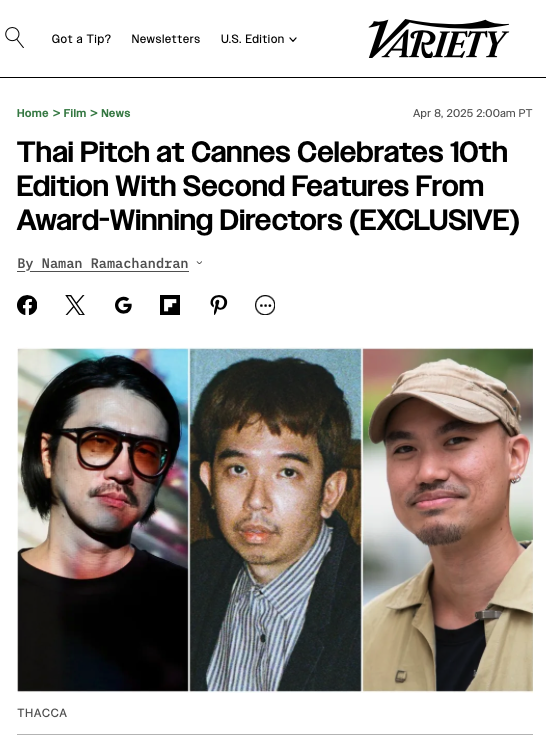
VARIETY : Ray of Light to be Showcased at the Thai Pitch at Cannes program

The Thailand Creative Culture Agency (THACCA) will present three promising sophomore features from acclaimed Thai filmmakers at this year’s Cannes Film Festival, marking the 10th edition of the Thai Pitch at Cannes program.

The pitching event, scheduled for May 19-20 at the Thai Pavilion in Village International, continues its mission of connecting Thai filmmakers with potential investors, co-producers, funders, sales agents, distributors and festival programmers. The initiative has established a strong track record of launching successful Thai productions into the international festival circuit.

Taiki Sakpisit returns with “The Blind Earthworm in the Labyrinth” after his Rotterdam Fipresci Prize-winning debut “The Edge of Daybreak” (2021). The new project follows sisters Chareeya and Chalika who, after their parents’ deaths, become entangled in desire and haunted by memories within Bangkok’s shadowy underworld. Producer Cattleya Paosrijaroen, whose credits include Apichatpong Weerasethakul’s Cannes Jury Prize winner “Memoria,” is attached.

Itt Patiparn Boontarig presents “Ghost of the Currents,” which follows his debut “Solids by the Seashore” (2023) that won multiple awards at the Busan International Film Festival. His new supernatural drama centers on a man who returns to his flood-ravaged Mekong riverside village where locals believe a vengeful “River Ghost” is responsible for the disaster.

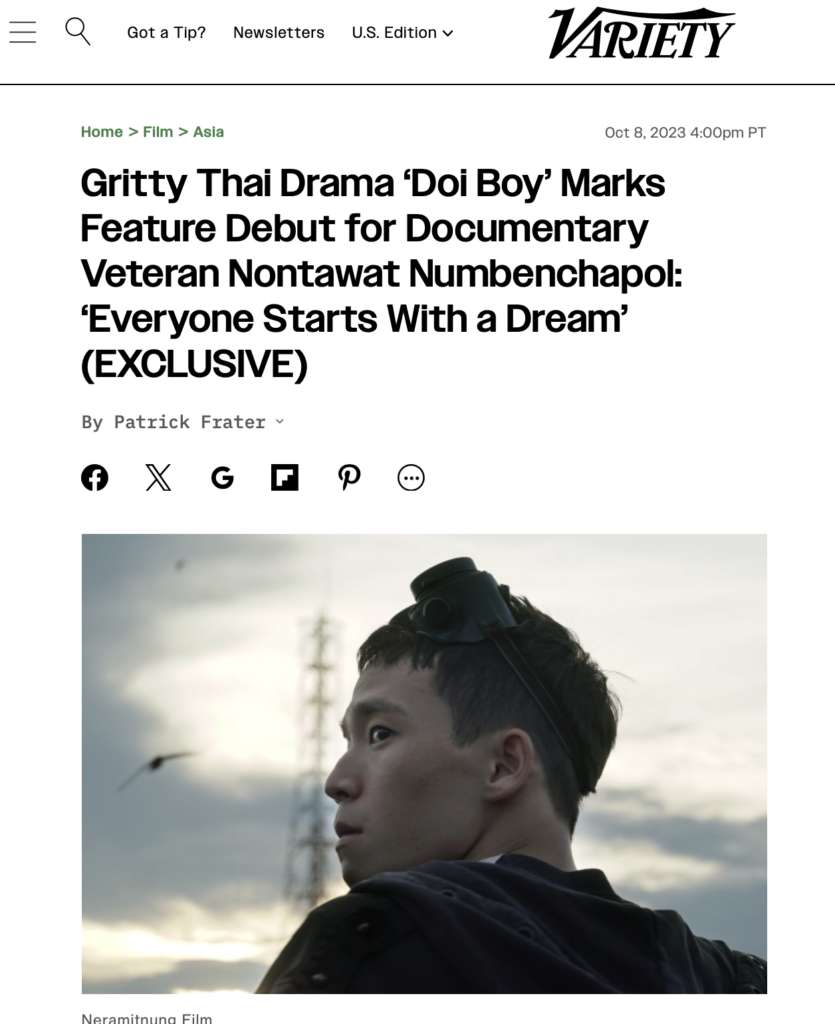
Nontawat Numbenchapol, who successfully transitioned from acclaimed documentary work to fiction with “Doi Boy” (2023), brings “Ray of Light,” a class-conscious drama set on a film production where a lighting technician and leading actress from vastly different worlds briefly connect. Veteran line producer Tanade Amornpiyalerk is producing.

All three projects recently received funding support from THACCA, with selection handled by a committee including Thai filmmaker-producer Pimpaka Towira, World Film Festival Bangkok director Donsaron Kovitvanitcha, and industry veteran Raymond Phathanavirangoon, who will coordinate the Cannes meetings.

Previous Thai Pitch success stories include “Arnold is a Model Student” (2022), “Anatomy of Time” (2021), “Die Tomorrow” (2017), and “Malila: The Farewell Flower” (2017), all of which secured international festival premieres and recognition.

Variety

March 2024

Nikkei Asia

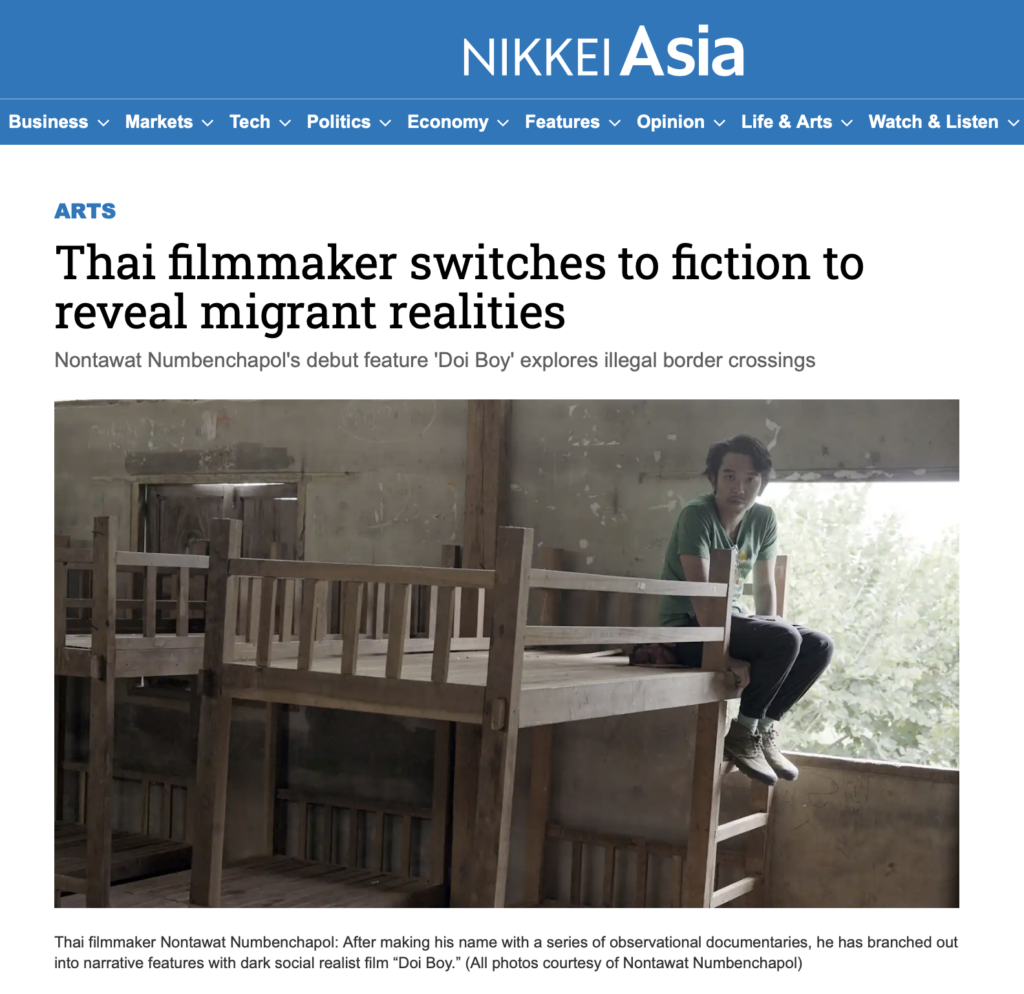
“Thai filmmaker switches to fiction to reveal migrant realities”
An interview in which Nontawat discusses his move from documentary to narrative fiction with his debut feature Doi Boy, choosing fiction to protect the identities of the migrant workers who inspired the story.

read more…


June 2023

ArtReview Asia

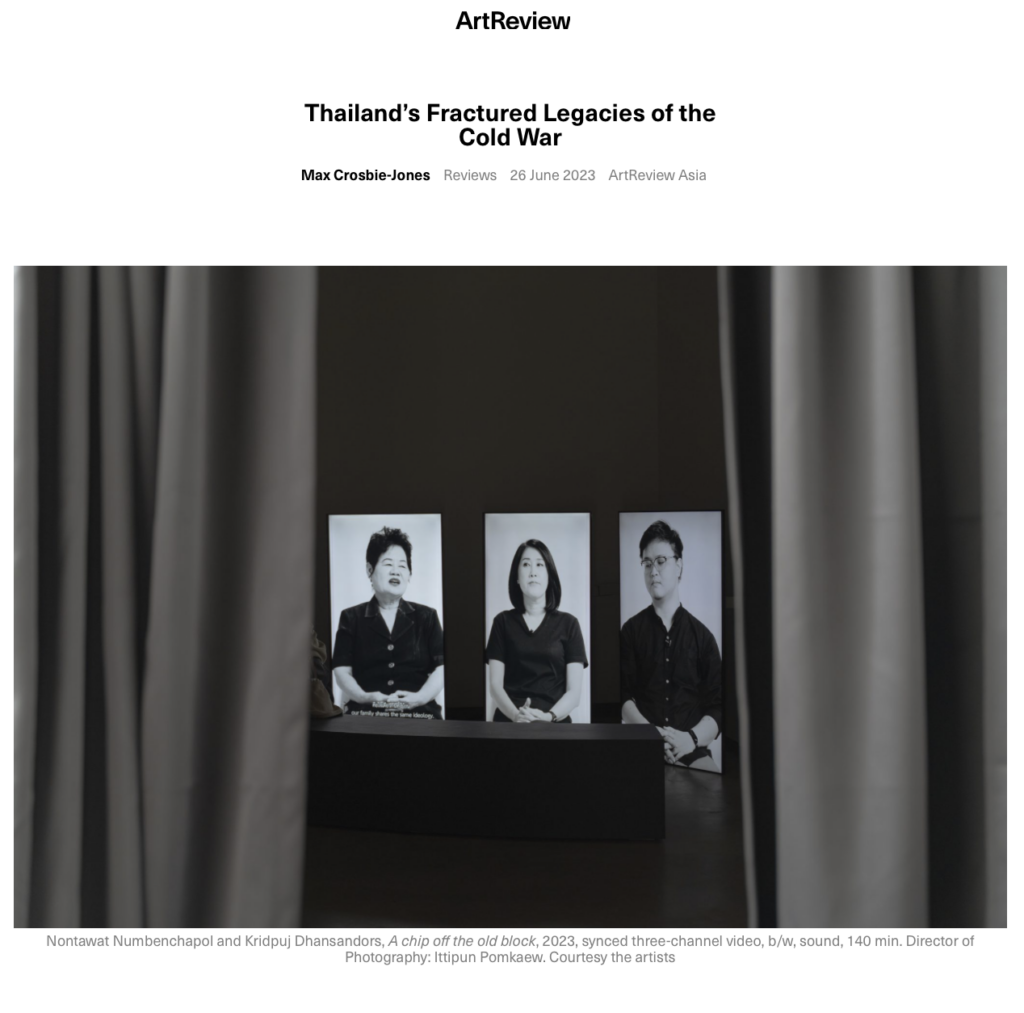
“Thailand’s Fractured Legacies of the Cold War”
A review of the group exhibition Uncountable Time at Jim Thompson Art Center, Bangkok, featuring Nontawat and Kridpuj Dhansandors’ three-channel video A chip off the old block, which confronts the lingering aftermath of Cold War–era political persecution in Thailand.

read more…

July 2020

AURA ASIA ART PROJECT

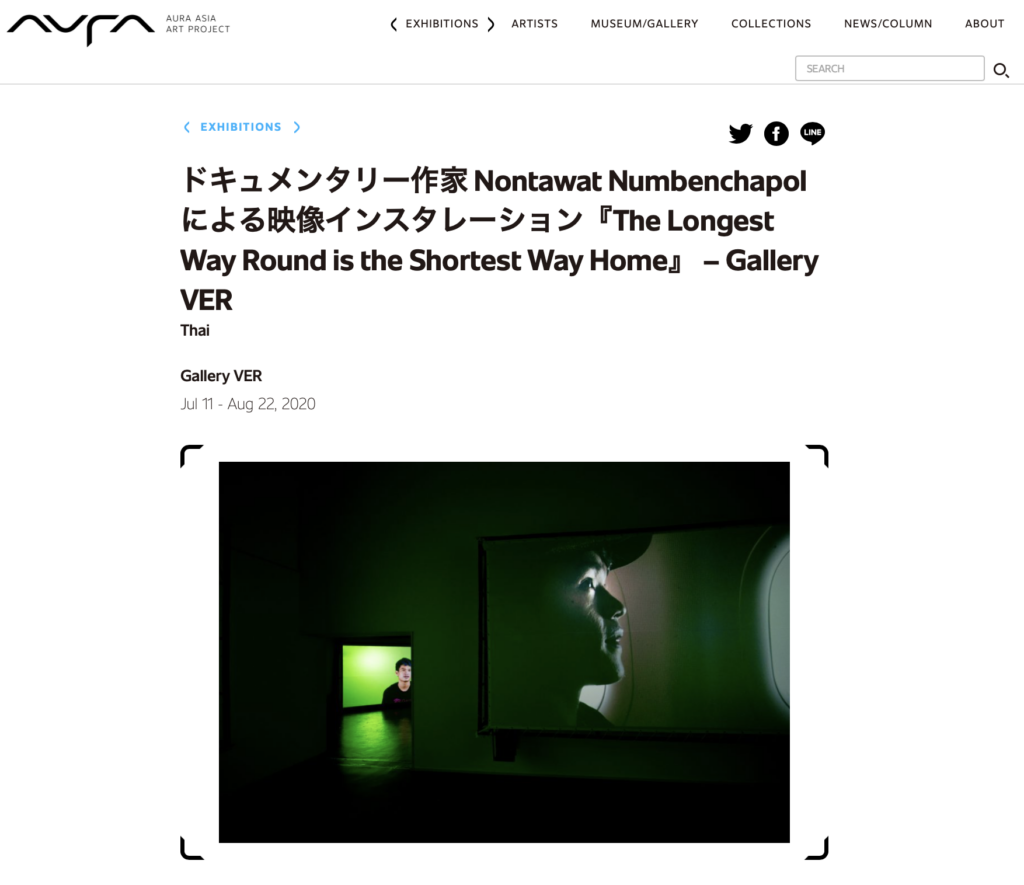
ドキュメンタリー作家 Nontawat Numbenchapol による映像インスタレーション『The Longest Way Round is the Shortest Way Home』 – Gallery VER

「近道は必ずしも最良の方法ではない」という慣用句を反映して、本作品『The Longest Way Round is the Shortest Way Home(最長の道は最短の道である)』は、しばしば法律文書なしに懸命な努力をしなければならない移住生活の複雑さとその不安定さを映し出します。『The Longest Way Round is the Shortest Way Home』のなかで、初めはより良い生活への近道として現れたのとは対照的に、特にミャンマーからタイへと、国境を越える行為は持続不可能な選択であることを明らかにします。システムとして社会から取り残された移民はしばしば、自由を制限されたり、祖国に戻ったりする以外に選択肢がないのです。

チェンマイのシャン人労働者に焦点を当てた『The Longest Way Round is the Shortest Way Home』の民族学的フレームは、ミャンマーの内陸部で撮影されたユニークな映像を通じて Numbenchapol の観察と現地リサーチを取り入れ、ある若者が6年後にシャン州の村に戻り、家族を訪ね、必要とされている国籍証明書の手続きをする旅をたどります。

撮影クルーを連れずに一人で撮影された Numbenchapol の映像は、主人公の移民としての自身の人生観、故郷を離れる痛み、国境を越えて新しい人生を抱くことへの期待を明らかにする、視覚的フィールドノートの集合体となっています。同時にその映像は、個人をつくる上で、自身の故郷、アイデンティティ、社会的な、またはその他の意味に帰属することとしないことについて、より大きな疑問を引き起こします。

引き込まれるような映像と音響インスタレーション、写真とミクストメディア作品とともに、『The Longest Way Round is the Shortest Way Home』は、東南アジアの国境を越えた包摂、排他、社会的需要の戦いについての対話を促することを目指し、また、同様のテーマの長編映画のためにNumbenchapol が行なっているチェンマイのシャン人労働者に関する現地リサーチの土台ともなっています。

アーティスト
Nontawat Numbenchapol は、フィクションやドキュメンタリー映画を制作しています。2013年には、タイとカンボジアの国境地帯に住む人々についての初ドキュメンタリー作品『Boundary』を制作しました。この映画はドイツのベルリン国際映画祭でプレミア上映されました。同年、Numbenchapol は水鉛汚染の影響を受けたKlity村に関する2作品目のドキュメンタリー映像『By the River』を制作し、ロカルノ映画祭でタイ映画として初めてスペシャル・メンション賞を受賞。2016年にはハイブリッド・ドキュ・フィクションの『#BKKY』を釜山国際映画祭でプレミア上映、ドイツの Lesbisch Schwule Filmtage Hamburg から長編特別優秀審査員賞を受賞しました。2016年以来、Numbenchapol はタイとミャンマーの国境で、シャン州軍の軍事キャンプでの若者たちの生活をリサーチしています。その経験に基づき『Soil without Land』をプロデュース、スイス・ニオンの Vision du reel、および 韓国・ソウルの DMZ DOCSを含む主要な映画祭で上映されました。現在は、ミャンマーからチェンマイにかけての避難民の少数民族に焦点を当ててリサーチを行っています。

キュレーター
Loredana Pazzini-Paracciani は、インディペンデント・キュレーター、作家であり、東南アジア・コンテンポラリーアート講師です。彼女のリサーチとキュレーター実践は、東南アジアにおける批評的社会政治問題に焦点を当て、反覇権主義的、非西洋中心的な議論を提唱しています。主な出版物に、『Frames Cinema Journal』(University of St Andrews、イギリス)、『Convocarte: Revista de Ciências da Arte』(Lisbon University、ポルトガル)、『M.A.tter Unbound』(LASALLE College of the Arts、シンガポール)など。イギリス「the Association for Southeast Asian Studies」、ベルリン大学「Research Network for Transcultural Practices in the Arts and Humanities」のメンバーでもあります。Patrick D. Flores と『the anthology Interlaced Journeys: Diaspora and the Contemporary in Southeast Asian Art』を共同編集、香港の Osage Art Foundation より2020年に出版されています。

アーティスト・プロフィール:

Nontawat Numbenchapol は1983年生まれ、バンコク育ち。タイ人映画監督、兼、テレビ番組のシナリオライターであり、彼のドキュメンタリー作品は広く知られています。ランシット大学芸術デザイン学部ビジュアルコミュニケーションデザイン学科卒業。

Numbenchapol は、カンヌ国際映画祭パルム・ドール受賞者であるアピチャッポン・ウィーラセタクンとたびたび協働してきました。主なプロジェクトに、『UNCLE BOONMEE WHO CAREN HIS PAST LIVES』(スチルカメラ)、『FOR TONIGHT』(撮影監督)、『FIREWORKS(ARCHIVES)』(プロジェクトマネージャー)、『CEMETERY OF SPLENDOUR』(メイキング映像)などがあります。

2013年、Numbenchapol は釜山国際映画祭とアート・ネットワーク・アジアの資金提供により、初めてのドキュメンタリー映像作品『BOUNDARY』を制作。これまで知られることのなかったタイ・カンボジア国境に暮らす地元住民の視点を描き出しました。Numbenchapol は、Bangkok Critics Assembly よりヤング・フィルムメーカーアワードを受賞し、『BOUNDARY』はベルリン国際映画祭、アムステルダム・ ドキュメンタリー国際映画祭(IDFA)、山形国際ドキュメンタリー映画祭など多くの映画フェスティバルで上映されました。同年、水鉛汚染の影響を受けたKlity村民について自身の二作品目となるドキュメンタリー『The RIVER』を制作。ロカルノ国際映画祭でタイ映画として初めて特別賞を受賞しました。

2016年には、人生とアイデンティティを問う10代の女の子「ジョジョ」の物語である、ハイブリッド・ドキュ・フィクション『#BKKY』を制作しました。ジョジョのキャラクターは、バンコクで高校を卒業したばかりの10代の若者100人に、自分たちの愛や夢、成人式についてインタビューしたものを編集したものです。2016年10月、釜山国際映画祭でプレミア上映され、ドイツの Lesbisch Schwule Filmtage Hamburg から長編特別優秀審査員賞を受賞しました。

AURA ASIA ART PROJECT

June 2020

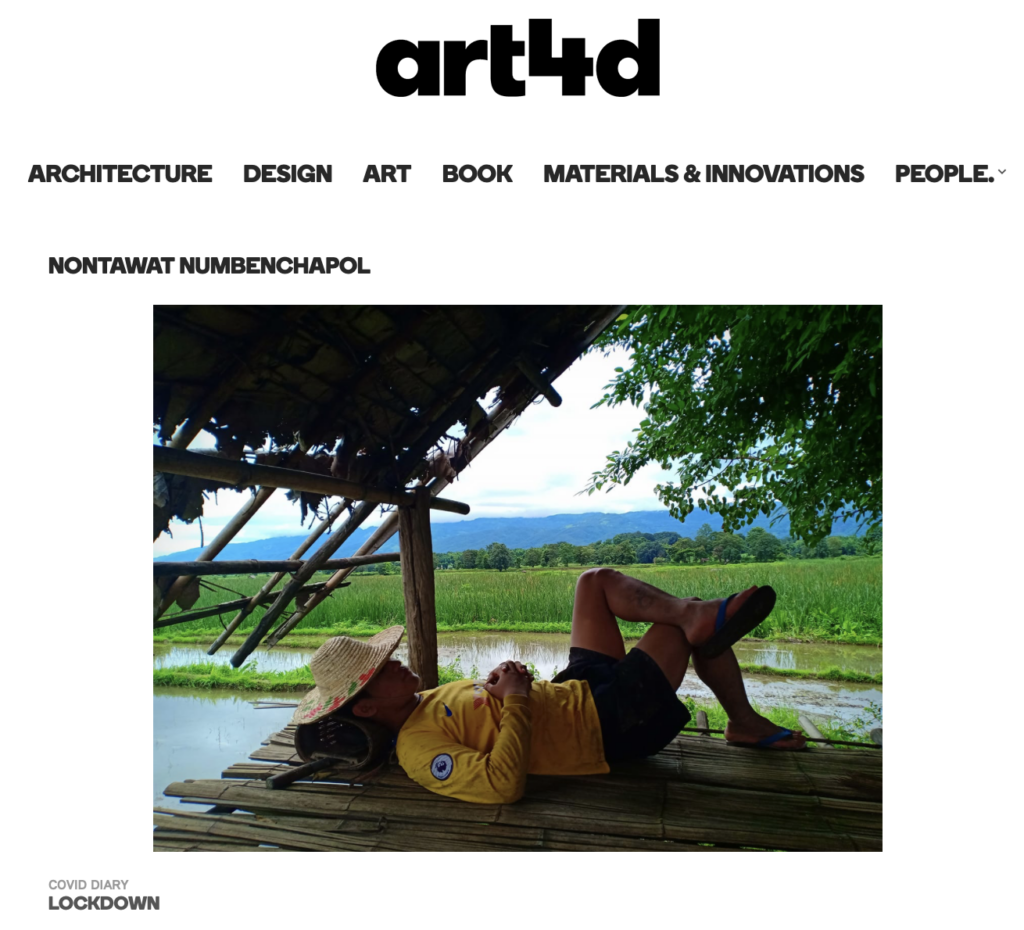
ART4D: COVID DIARY LOCKDOWN

I’ve been telling myself throughout this COVID-19 situation that I’m lucky that the lockdown allows me to stay home and finish editing all my works, after having spent the entire year in researching and producing a great many sources. Among those is what I’ll be presenting at Ver Gallery on July 11.

For this work, I picked one interviewee, out of scores of Burmese immigrants who work at bars and live in Chiang Mai, hoping for better lives.

I became friends with many of them, following their lives from a distance via Facebook feeds. For the one I chose, I offered him what I, and he, wanted the most, taking him across the border back to his hometown in Shan State, after six years away. I asked for his permission to film this.

Editing works, I haven’t set my feet out for a month, feeling I have more time than ever before reconsidering what I’m doing.

I’m still following their lives, at home via Facebook. All of them are unemployed because of the closure of the bars. Many couldn’t go home and need to take any available jobs, mostly daytime construction work—the one in my artwork as well.

Occasionally, I ask him how he’s holding up. He has 200 baht left, having instant noodles with eggs everyday. His Thai girlfriend also works a nightlife job. She’s not qualified for the government’s 5,000-baht relief subsidy, but some of my friends who’re doing much better financially are. I can’t help questioning the management of this relief.

Two months have passed: Thailand’s COVID-19 infection rate is at a satisfactory level; the suicide rate is, though, higher than that of COVID-19 related deaths. This is a fruitful outcome of the government’s masterful restriction of people’s rights by imposing curfews. The total opposite can be said for their people’s management skills, judging from the relief and healing measures. The gaps between social classes have been made clear, and those who don’t have access to resources, in particular, are bogged down and cannot find a possible way to continue living in this area of the Earth called Thailand.

ART4D

January 2019

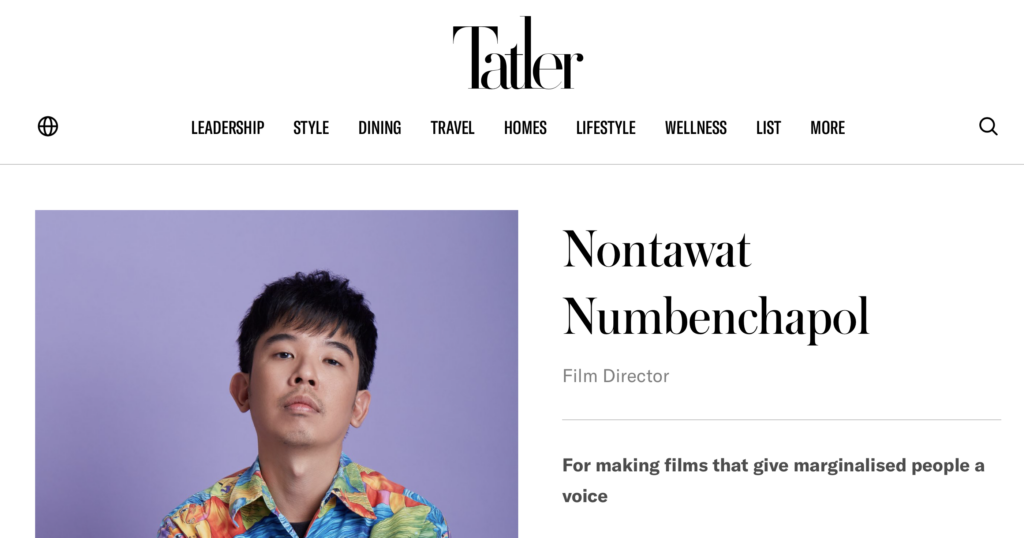
Tatler Asia

Gen.T Leaders of Tomorrow (Thailand)
Named to Tatler’s Gen.T list of Thailand’s most promising young leaders — recognised among the region’s trailblazing creatives and changemakers for his socially engaged documentary work.

read more…

September 2018

Asian Movie Pulse 

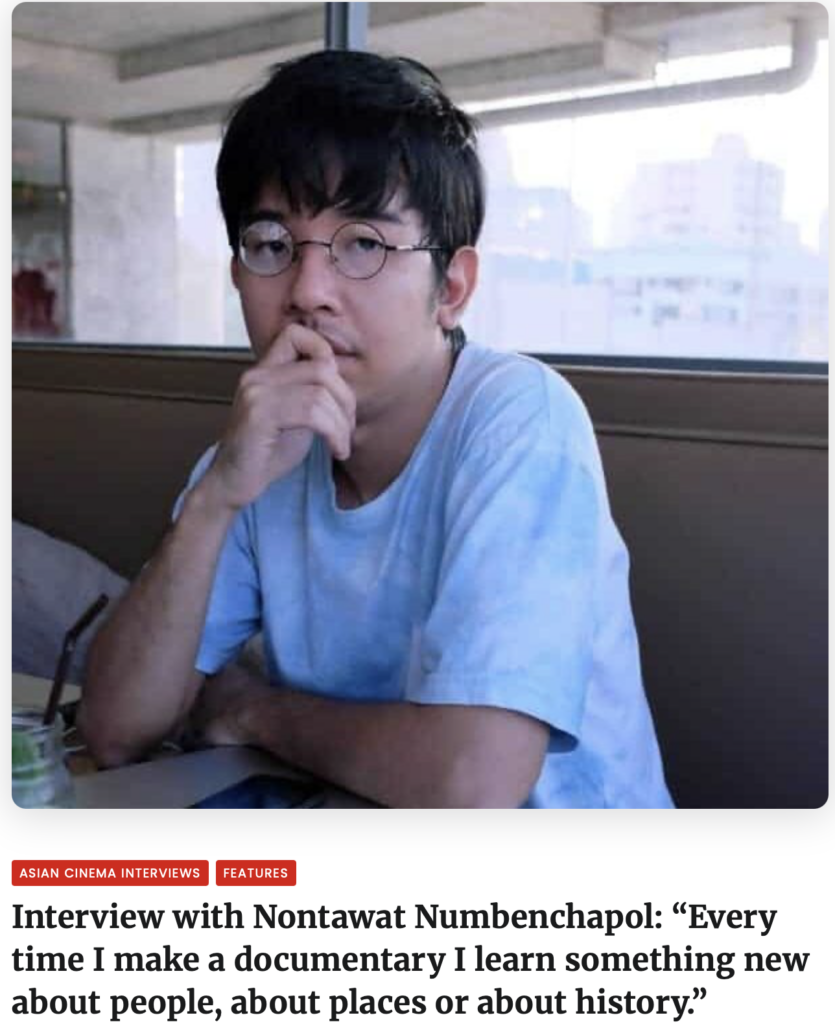
“Every time I make a documentary I learn something new about people, about places or about history”
An in-depth interview tracing Nontawat’s approach to documentary filmmaking and the recurring themes of history, identity, and borders that run through his work.

read more…

October 2017

Bodies of Occupation: Conversation with Nontawat Numbenchapol

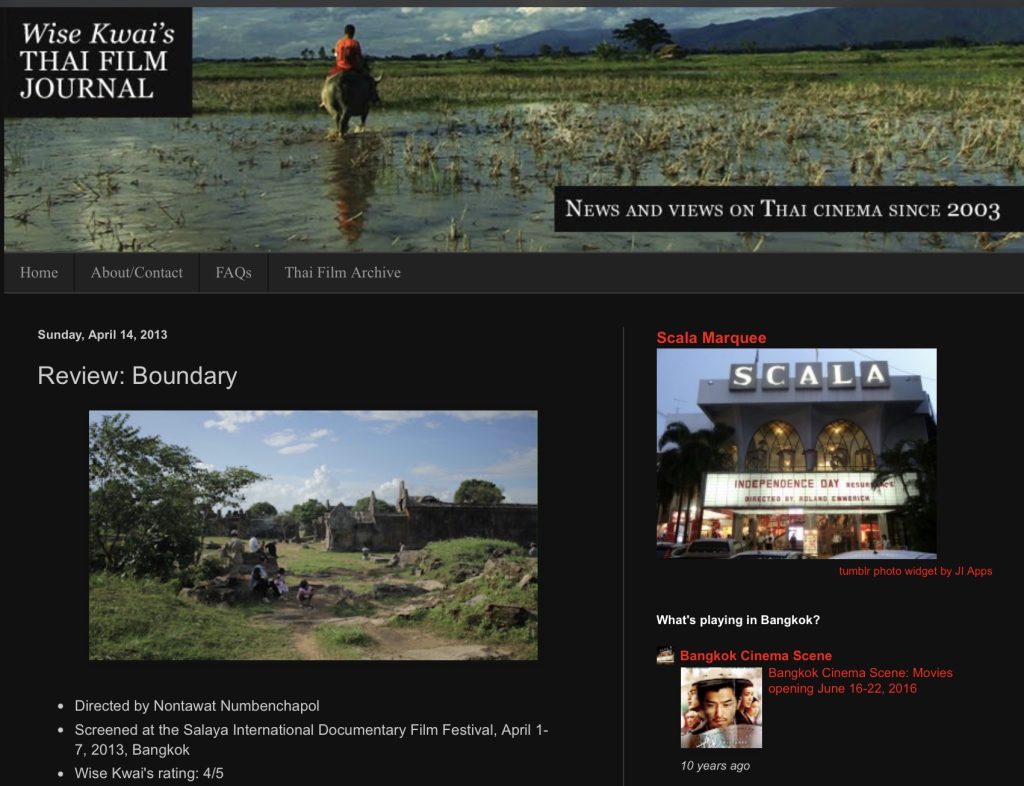
This conversation with the film director Nontawat Numbenchapol on his movie Boundary(2013), which follows a young soldier called in Bangkok to break up the “red shirts” protest (2011) to his hometown in Sisatek, a zone of conflict between Thailand and Cambodia due to the ongoing political dispute between the two countries over the Preah Vihear Temple. Boundary was funded by Busan International Film Festival and Art Network Asia. Numbenchapol received the Young Filmmaker award from the Bangkok Critics Assembly and Boundary screened across many film festivals such as Berlin International Film Festival, International Documentary Film Festival Amsterdam (IDFA), and Yamagata International Documentary Film Festival.

Read more..

November 2013

The Hollywood Reporter : By the River

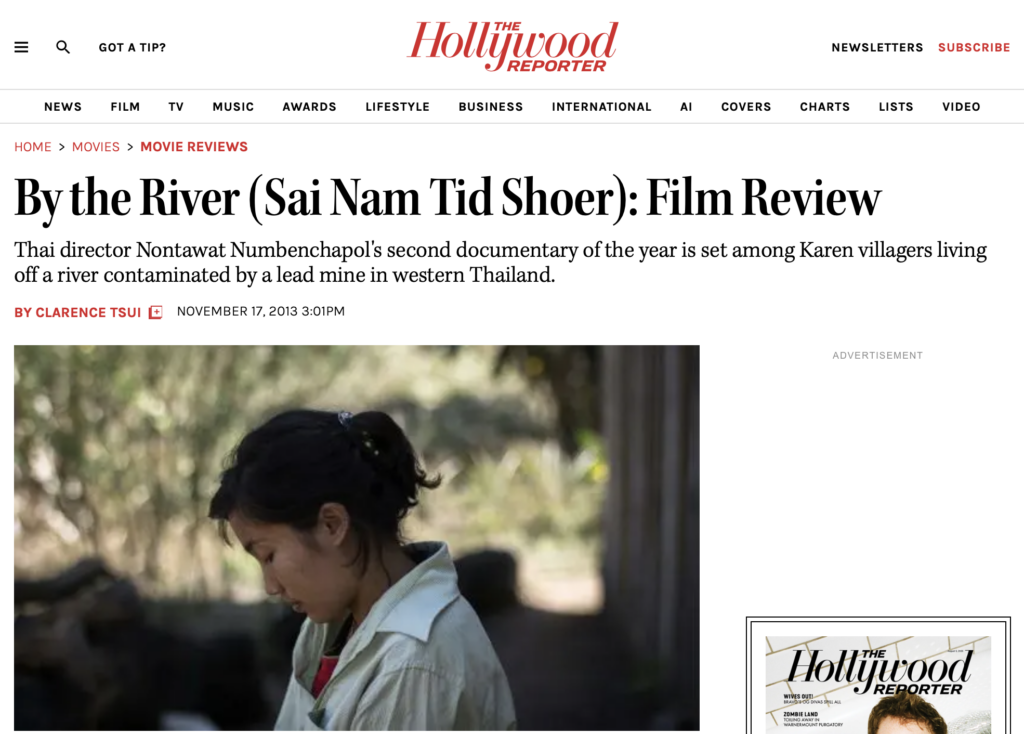
By the River (Sai Nam Tid Shoer): Film Review”
A review of By the River, Nontawat’s documentary on a Karen village living beside a lead-contaminated creek in Kanchanaburi — praised as a quiet, composed meditation on rural lives and environmental injustice.

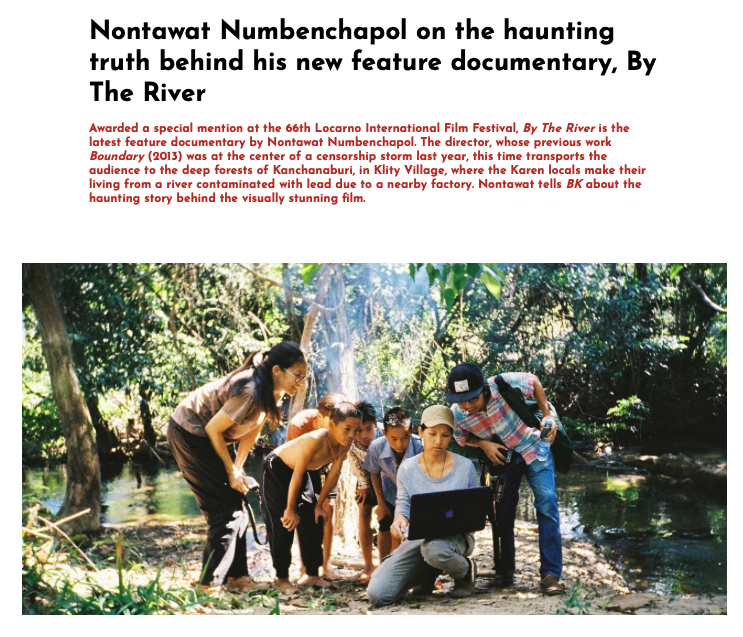
Just months after gracing the Berlinale with Boundary – a documentary which touches on the once-deadly and still-festering frontier row between Thailand and Cambodia – Nontawat Numbenchapol has swiftly reappeared with yet another piece digging into yet another controversy set in his home country’s far-flung borderlands: By the River revolves around a village in western Thailand still reeling from the ecological disaster brought about by contamination from a leaking lead mine.

Not that By the River will be troubling Thai censors as Boundary did back in April though, when the film was initially banned from domestic release before the authorities backtracked two days later and granted permission for screenings: the issue at hand here is certainly less politically sensitive here, and Nontawat’s treatment also leans towards the contemplative and poetic than his previous film which, though hardly a hard-edged critique on the status quo, comprises mentions of fatalities of a government crackdown on demonstrations in 2010 and also a Cambodian soldier’s condemnation of the Thai government’s military maneuvers.

While certainly made with the palpable aim of raising debates about the environmental catastrophes rural dwellers have endured so as to keep cities (and their social elites) thriving, By the River conducts its argument by revealing gently the lingering pain and anguish beneath lush, pastoral vistas which have seemingly recovered from that deadly eco-calamity 15 years ago. Like Boundary, By the River would certainly build on the acclaim it has already received ever since its premiere at Locarno (where it was garlanded with a Special Mention nod), with its appearances at Yamagata, Hong Kong and (in a fortnight’s time) Luang Prabang signaling more stops on the festival circuit, and also green-themed events beyond Asia.

For the uninitiated, By the River could easily pass off as simply a depictment of rural life in Thailand: it will be nearly halfway into this 67-minute film that a combination of visuals (petitions at the town hall, court hearings) and on-screen text would bring to the fore the sufferings of Lower Klity, where its inhabitants – who belong to the Karen ethnic minority – felt the brunt of toxic waste seeping from a lead mine into the river which their lives depend on.

But the villager’s calm, quotidian existence and quiet laments – a man on crutches speaking to his listless friend about his and others’ physical ailments; a gentle schoolteacher helping local children to learn the alphabet; an old woman talking about her optic nerves shattered by exposure to the poison – only heightens the feeling of a haven lost, with these marginalized and hapless villagers becoming sacrifices for the well-being of the unseen urbanites out there in Bangkok. One of Nontawat’s on-screen texts ruminates how the Karen people’s tribute to their powerful rulers for four centuries is now just repaid by lead – and now these silent sufferings have remained unheard by the center. “Will the waste dumped 30 to 40 years ago finally reach the Gulf of Thailand?” the director asks through another intertitle; By the River is perhaps that catalyst designed to carry this message downwater more rapidly, more urgently.

Given how the catastrophe began because of a river’s flowing currents, Nontawat’s film puts nature and its elements the very center of its visual narrative. Water, of course, is omnipresent; the underwater scenes – in which boys prod the riverbed for fish, an act which also points to possible toxin which might have remained there – provides some kinetic counterpoint to mostly slow-burning sequences, such as the static observations of, say, how human life and poetic scenarios (a reflected moon slowly morphing into something akin an expanding star) burst out of the stream. And then there are the ashes, the remnants of burning embers and also the funereal pyre of a man recently deceased.

While Nontawat sometimes errs towards an excessive mournful tone (he could easily have cut back on the use of the fade-to-black) but By the River remains an enchanting piece which could bring forth more awareness of misery in the margins – which the Karen people are certainly confined to, an issue which has also been raised in October by Sopawan Boonnimitra and Peerachai Kerdsint‘s Busan festival entry The Isthmus. But while the latter is mired mid-way in between direct political engagement and melancholic meanderings, Nontawat’s offering goes straight for the unsaid to nudge people towards social advocacy, with engaging results.

Venue: Hong Kong Asian Film Festival
Production Companies: Ok-Pi-Dern and Mobilelab
Director: Nontawat Numbenchapol
Co-producer: Theepisit Mahaneeranonit
Executive Producers: Krittavit Rimtheparthip, Somchai Suwanban
Cinematographers: Withit Chanhamarit, Nontawat Numbenchapol, Grisda Saisungchalao, Gumpa Funfeo, Vichai Ogan Nasuanbarisut
Editor: Wasunan Hutawet
Music: Karen Musicians, Uncle Pachong, Auntie Meaonong In Karen and Thai
67 minutes

Hoolywood Reporter

August 2013

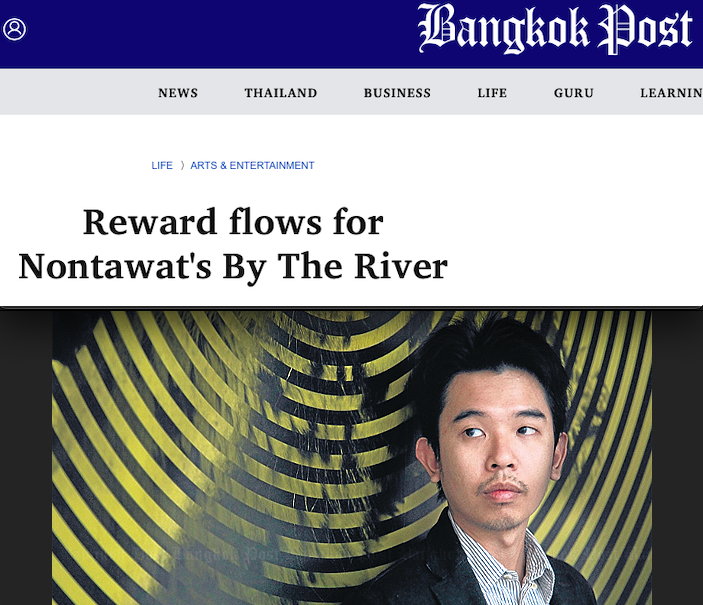
Bangkok Post : Reward flows for Nontawat’s By the River

After a rough start, Nontawat Numbenchapol is enjoying a rewarding year. On Sunday, the 66th Locarno International Film Festival in Switzerland, one of Europe’s oldest cinefests and a much-respected jamboree of art-house movies, awarded a Special Mention prize to his new film By The River, which tells the story of Lower Klity village in Kanchanaburi province, where residents have been affected by lead poisoning incidents.

The film’s Thai title is Maenam Tid Chua, or literally “infected river”. The version that won the prize in Locarno runs slightly over one hour, but the film was originally conceived and broadcast for the Thai PBS channel. The television version, which aired a few months ago, was only 22 minutes long.

The director, along with his producer at Ok Pai Dern company, will explore the possibility of releasing the full version in cinemas.

The Karen village of Klity has been in the news for decades after its main creek suffered lead contamination, a disastrous result of mining since the 1970s, which has seriously threatened the lives and well-being of villagers.


After lengthy legal battles, last year the Supreme Court made an important ruling by ordering the Pollution Control Department to clean up Klity Creek.

By The River, however, tells the story with the eye of an impressionist painter: the film largely consists of tranquil, breathtaking shots of the nature around the village, with minimal dialogue that only alludes to the fatal aftermath of the environmental horror. Children play and young men in the village still go spear-fishing _ and one of them becomes the latest victim of the contaminated creek that looks so inviting on the surface.

There’s only one section of the film that captures the scenes at a Bangkok court when the Karen villagers arrive for the hearing.

This is the second Nontawat documentary film to make the news this year.

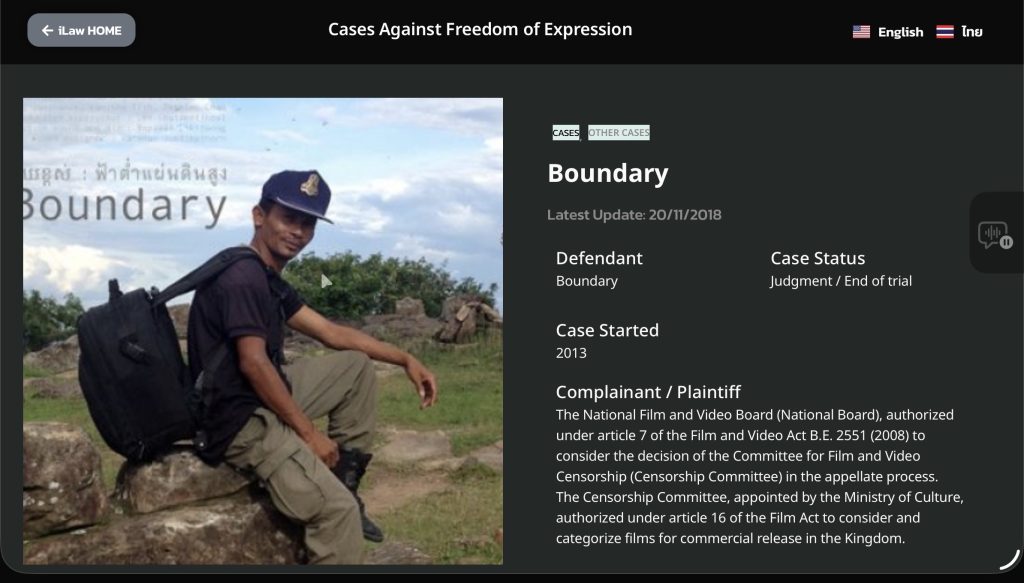
On April 30, the director found himself in one of the year’s most perplexing headlines: his documentary film Boundary (Fah Tam Pandin Soong), which discusses the Thai-Cambodian border conflict, was banned by Thai censors _ only to be un-banned and cleared for screening two days later.

The film board even apologised to the director and said a “technical error” led to its initial decision.

Boundary had a limited release in cinemas in June.

By The River won the prize in the Cinema of the Present section, which focuses on young and up-and-coming filmmakers.

_ Kong Rithdee

Bangkok Post


August 2013

Asian Movie Pulse

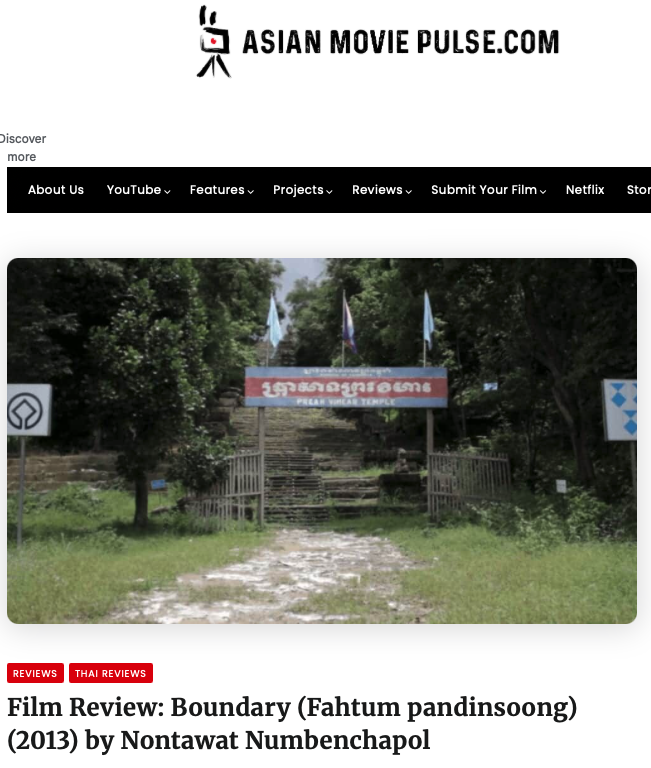
Even though one might not have the specific oversight of the political and social upheavals in Thailand and Cambodia, the story of the red shirt/yellow shirt divide and the Preah Vihear Temple-debate are symbols of a growing divide. While the former has increased the chasm between rural and urban Thailand as well as its social classes, the latter has resulted in conflicts which have shaken the border region between the two states. By the end of 2010, only months after the red shirt protests opposing the government, the social and political fabric of Thailand could not have been more damaged.

It was during this time – more precisely during New Years Eve 2010 – when Thai filmmaker Nontawat Numbenchapol found the subject for his first documentary. In a statement to his debut feature “Boundary,” the director says he was working on another project when he started thinking about the nature of boundaries and borders. However, it was not so much the geographical definition which he was interested in, but more the emotional and spiritual boundaries within society. While a celebration meant to unite people expecting the promises and possibilities of the new year, Numbenchapol saw a country more divided than ever. And while the positivism of the celebration may fade, the feeling of unrest, upheaval and violence led to the question of how deep the change had been, how visible the scars and the wounds of the past months were.

However, it was not so much the nature of his new film, but also the reaction of the state which answered this question to some extent. Because the film represented a “threat to national security and international relations,” it was banned in Thailand by the state, a rare procedure which made Numbenchapol join the ranks of colleagues like Apichatpong Weerasethakul and Tanwarin Sukkupisit, whose films had also been banned. Ironically, as many journalists pointed out, the same rating system banning these films saw no problem with films like “The Hangover Part II”, a movie whose portrayal of the country and its people is more than just problematic to say the least. Following the director’s appeal, “Boundary” was in the end re-edited with some small parts of the film in which the sound had to be muted and eventually the ban was lifted.

Film review subscription


For a movie which is essentially about the nature of human division and the social fabric of a country, Numbenchapol’s images are often eerily static and quiet. Often combined with  long takes of drives through villages, of fields and buildings as well as people moving through the landscape, a viewer may get the impression of a state of shock as the omnipresent condition of the film. Indeed, given the immediacy of the past events, the nature of the conflicts shown in the film, sometimes only present in the words of the people in front of the camera, and the seriousness of the wounds in the landscape, no one should be surprised by this condition. As the camera follows a man re-telling the story of his escape from bombings or a woman breaking out in tears having lost her home and belongings, the bomb craters in the ground reflect the emotional scar tissue of the people the movie shows.

Naturally, words are somewhat flawed in this environment. Numbenchapol’s use of long takes, sparse sub-titles and the long silences of the people he interviews represent repercussions of a long, brutal and still ongoing conflict. While some may be invisible on the surface, any attentive viewer will soon look closer at the images, the expressions and the landscape finding traces of these events and what they have left behind.

Most importantly, as the title of the film suggests, the camera looks at the nature the boundaries, physical and psychological, created in the course of time. The director follows a more universal approach concerning these matters, one which is, at the same time, closely connected to the setting of the film, but applicable to the nature of conflicts anywhere in the world. Whether it is about red shirts or yellow shirts, Thai or Cambodian, rural or urban background, there are two aspects “Boundary” focuses on: how much we admit these boundaries as a force in our lives, and to what extent outside factors (politics, religion, class) have emphasized them over time.

Additionally, the atmospheric use of sound and music composed by Katenan Juntimathorn stresses the contemplative nature of the film. Especially in the scenes showing the relationship of people and their environment, the director’s approach works best to present the traumatizing effects of the conflict, of the divide between people. At times, the somewhat helpless, sometimes hopeful expression captured in the eye of the camera may show a glimpse of the promise a new year has in store, the possibility of healing the wounds at some point in time.

Queer film streaming


Discover more


“Boundary” is an impressive piece of work about the nature of human divisions, about conflict and the wounds these leave behind. While at times difficult to endure, given the nature of the images shown on screen, Numbenchapol still maintains a small glimpse of hope, a curiosity in the people and landscapes he shows. In the end, maybe it is this kind of feeling which may resolve the issue, which may bring forward what unites rather than divides people.

Asian Movie Pulse

June 2013

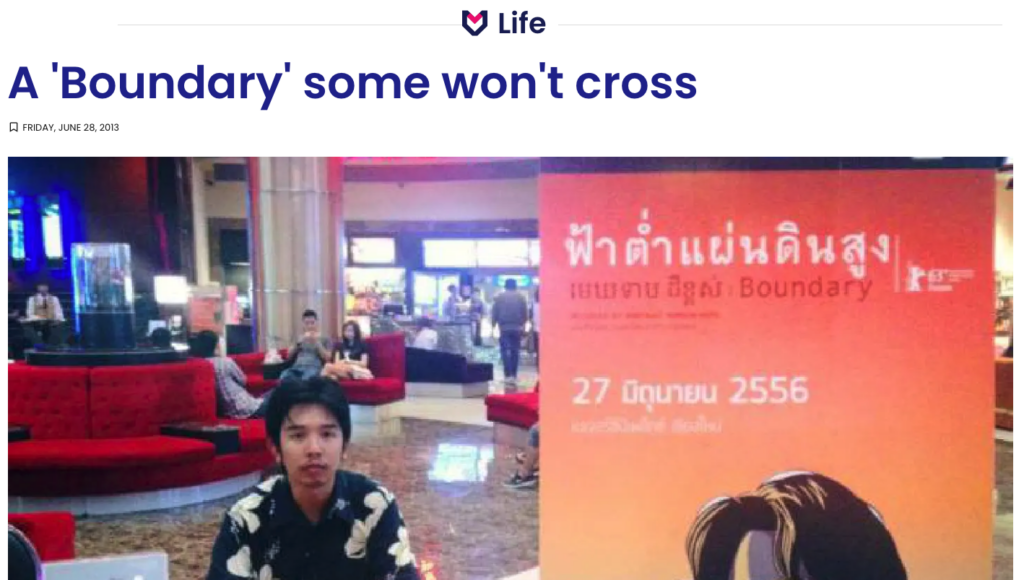
The Nation: A ‘Boundary’ some won’t cross

Nontawat Numbenchapol thought he was just making his first feature-length film. It turned out he was baking a hot potato. “Boundary” (“Fahtum Pandinsoong”) immediately got a lot of free publicity when the Film and Video Board decided it couldn’t be shown. But they and nontawat talked things over and they said, “Okay, never mind.” So a press screening was set up this past Monday, only for word spread on Facebook that Major Cineplex might not allow “Boundary” to be shown. But then they and Nontawat talked things over and came to an agreement. “Boundary” is screening at the Major Cineplex Airport Plaza in Chiang Mai until tomorrow. It’ll then be at the EGV Tesco Lotus in Khon Kaen next Thursday and Friday and then at the Major Cineplex Udon Thani on July 16 and 17. It returns to Bangkok’s Esplanade Ratchada on July 18. Major Cineplex remains nervous enough about the movie that it won’t sell “Boundary” tickets through its own system. So Nontawat has to sit in the theatre lobby saying “Pssssst!” Just look for him an hour before showtime and slip him a red.

The Nation…

April 2013

THE DIPLOMAT : Thailand Bans Film on Preah Vihear

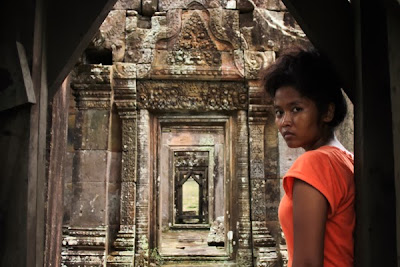
Two days after Thai authorities banned Boundary, a documentary about Thailand’s festering border dispute with Cambodia at Preah Vihear, censors have lifted the ban, citing a “technical mistake”. The ban occurred as the International Court of Justice (ICJ) prepares to make a ruling over territory surrounding the 11th century ruins.

Initially, Thai film censors claimed the documentary, which was directed by Nontawat Numbenchapol and debuted in February at the Berlin International Film Festival, was a threat to national security and international relations.

Further, authorities explained that a subcommittee with insufficient authority issued the ban. After watching the film for a second time on Thursday afternoon, censors changed their tune and said they found it inoffensive. The film has since been approved for viewers of 18 years and above.

The film, Boundary, is an account of the border conflict that erupted in 2008 as told by a former soldier living in the area and villagers from Cambodia and Thailand. When fighting intensified two years ago, 17 soldiers and one civilian were killed, while thousands of villagers were displaced.

Last year troops withdrew from the hilltop in the Dangrek Mountains after a demilitarized zone was established in The Hague.

Accounts from both sides of the conflict dating back to a 1962 ICJ rulingare detailed, but apparently a sub-committee governing film and video screening dismissed some of the Cambodian accounts as groundless, adding that some of this information was still before the court.

The ICJ is expected to clarify its 1962 ruling, which ruled that the thousand-year-old temple belonged to Cambodia but failed to definitively demarcate the borders surrounding the site. The land where Preah Vihear sits was occupied by the Khmer Rouge throughout Cambodia’s long running civil wars.

Although it has been lifted, the short-lived ban of Boundary was not an isolated case. Thai censors have made similarly questionable interpretations and harsh rulings in the past.

In 2011, a movie about a transgender father trying to raise two children – Insects in the Backyard – was deemed immoral and banned, while last year a local adaptation of Shakespeare’s Macbeth was banned amid arguments that it was divisive.

Thankfully, things turned out differently for Boundary and Numbenchapol’s film can now have an audience.

In an interview with the Hollywood Report Numbenchapol said, “Everyone I’ve spoken with who’s seen it says the film shows the point of view of every side, and that the film is neutral.”

He continued, “My intention was to let the film be a space for the people in the troubled territories to voice their views and feelings to the outside world – which they haven’t had a chance to express in other Thai media.”

The Diplomat

April 2013

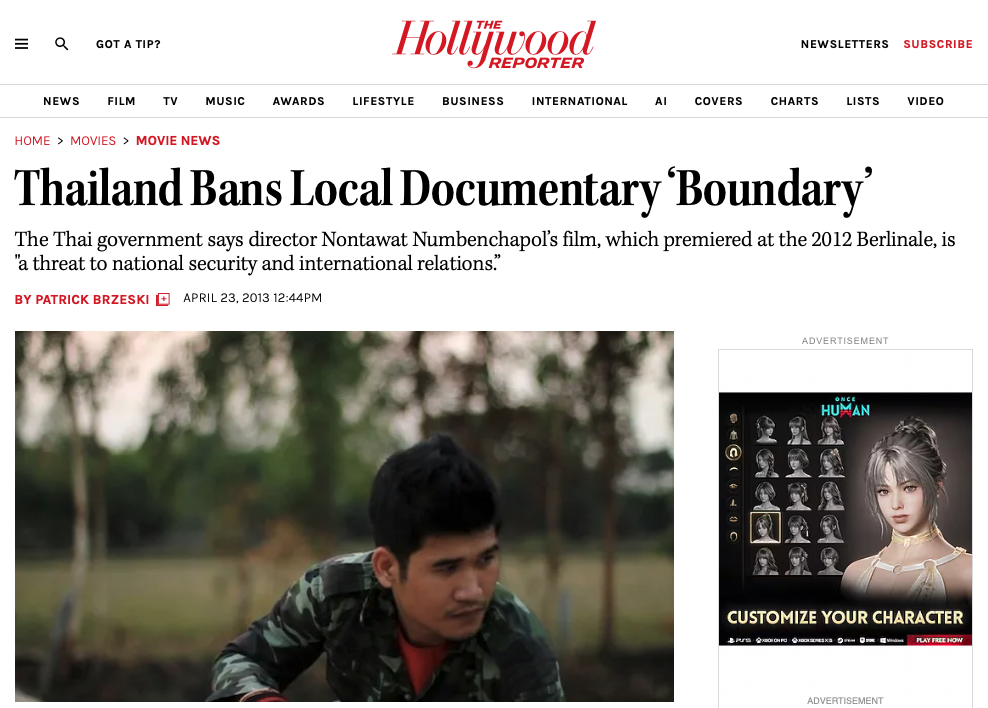
Hollywood Reporter : Thailand Bans Local Documentary ‘Boundary’

Thai director Nontawat Numbenchapol’s independent documentary Boundary appears to have met one.

The Thai government announced a countrywide ban on the film Tuesday, saying its content is “a threat to national security and international relations.”

A modestly budgeted art-house doc, Boundary premiered at the Berlin International Film Festival in February. The film begins with footage of the so-called “red shirt” political protests that paralyzed Bangkok in 2010 and resulted in an armed standoff and the deaths of nearly 100 people. Nontawat then zeros in on one of the soldiers involved in the dispute and follows him to his hometown along the Thailand-Cambodia border, an area that has long been the focus of an occasionally violent border dispute between the two countries.

Conversations between the soldier, Nontawat and Cambodian and Thai villagers are overlaid upon scenes of the rural countryside, glimpses of damage wrought by the conflict and shots of an historic, 1,000-year-old Hindu temple, which both Thailand and Cambodia claim as their own, and which has often served as the fulcrum of the ongoing border spat.

On April 15, the UN’s International Court of Justice began a hearing over the temple and the surrounding area depicted in Boundary. Fighting in the region left 18 people dead and thousands of villagers displaced in April 2011. Thailand and Cambodia both made their cases for claim to the territory last week and are currently awaiting the UN high court’s decision, hoping for a resolution. Apart from the territorial issue, relations between the two countries are mostly positive, and they remain strong trading partners.

“I really didn’t expect this film to be banned,” Nontawat told The Hollywood Reporter. “Everyone I’ve spoken with who’s seen it says the film shows the point of view of every side, and that the film is neutral. My intention was to let the film be a space for the people in the troubled territories to voice their views and feelings to the outside world — which they haven’t had a chance to express in other Thai media.”

Referring to either the Red Shirt protests from 2010, or the border dispute with Cambodia — or both — the Thai Ministry of Culture division that issued the ban, added: “The film presents some information on incidents that are still being deliberated by the Thai court and that have not yet been officially concluded.”

Representatives from the Thai government were not immediately reachable for comment.

Thailand has a ratings classification system, but films can still be outright denied for mass consumption. Such bans are relatively rare, but there have been notable incidents, such as the barring of Palme d’Or winner Apichatpong Weerasethakul’s Syndromes and a Centuryin 2007, and Tanwarin Sukkhapisit’s Insects in the Backyard (2010), a drama about a self-destructive transsexual raising two teenagers who turn to prostitution. More recently, Thailand banned local director Ing K‘s Shakespeare Must Die (2012), which was billed as a Thai adaptation of Macbeth with contemporary political overtones. At the time, the government said its content “causes divisiveness among the people of the nation.”

Hollywood has fared comparatively better in recent years. Despite some local outcry over the Hangover 2’s stereotypical portrayal of the country as a place of prostitution and seedy intrigue — along with a fight scene set in a Buddhist monastery, which some in the Buddhist-majority country found blasphemous — the film was given the official thumbs-up for screening.

Nontawat says he and his producers were planning a limited release for Boundary at a few independent cinemas in Bangkok. The director says he now plans to appeal the ruling with the country’s National Film Board, but he is not optimistic for a reversal.

“Before Boundary, Insects in the Backyard and Shakespeare Must Diewere banned, and they both went to the administrative court, but they still haven’t gotten an answer,” he said. “I think it’s useless to appeal, but what else I can do?”

Hollywood Reporter…

January 2012

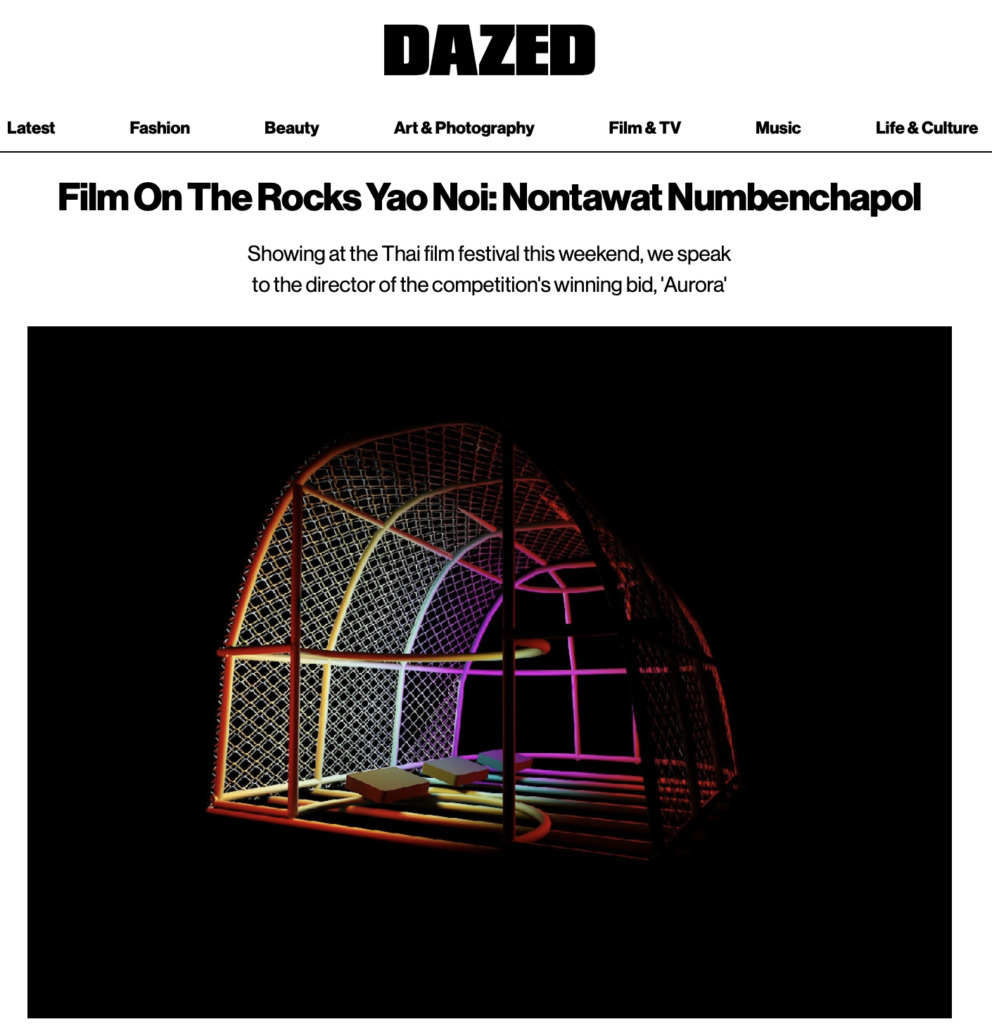
Dazed : Film On The Rocks Yao Noi: Nontawat Numbenchapol

“Film On The Rocks Yao Noi: Nontawat Numbenchapol”
An early interview around Aurora, his winning proposal for the Film on the Rocks Yao Noi lab curated by Apichatpong Weerasethakul — a three-projector installation on memory, light, and loss.

read more…