“By the River (Sai Nam Tid Shoer): Film Review”
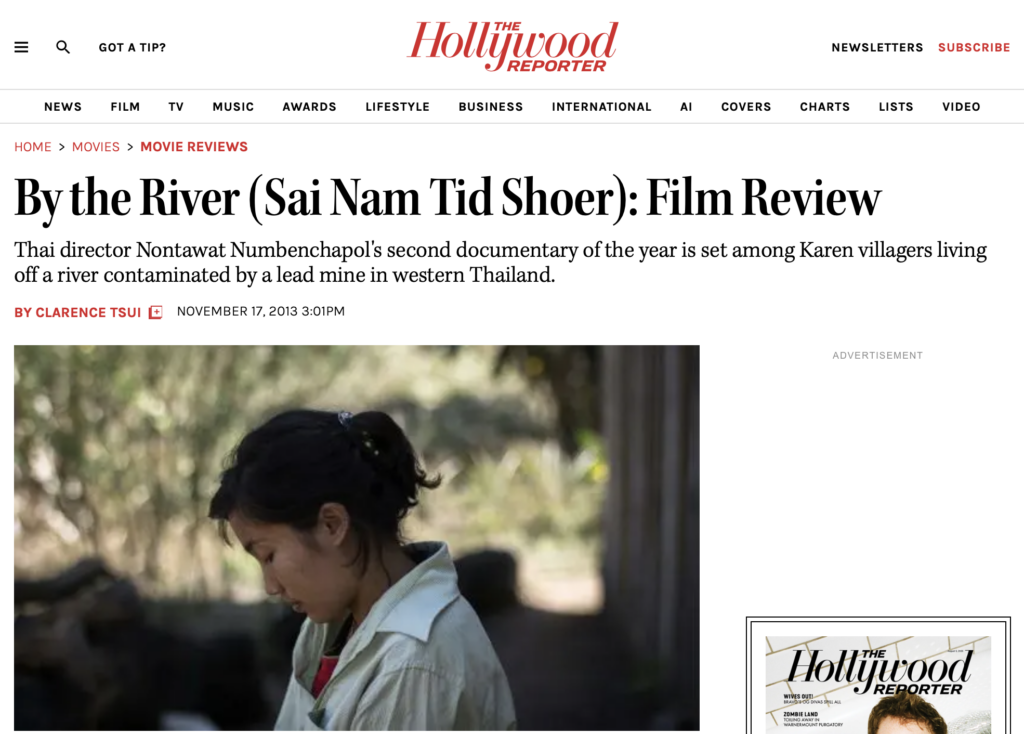
A review of By the River, Nontawat’s documentary on a Karen village living beside a lead-contaminated creek in Kanchanaburi — praised as a quiet, composed meditation on rural lives and environmental injustice.
Just months after gracing the Berlinale with Boundary – a documentary which touches on the once-deadly and still-festering frontier row between Thailand and Cambodia – Nontawat Numbenchapol has swiftly reappeared with yet another piece digging into yet another controversy set in his home country’s far-flung borderlands: By the River revolves around a village in western Thailand still reeling from the ecological disaster brought about by contamination from a leaking lead mine.
Not that By the River will be troubling Thai censors as Boundary did back in April though, when the film was initially banned from domestic release before the authorities backtracked two days later and granted permission for screenings: the issue at hand here is certainly less politically sensitive here, and Nontawat’s treatment also leans towards the contemplative and poetic than his previous film which, though hardly a hard-edged critique on the status quo, comprises mentions of fatalities of a government crackdown on demonstrations in 2010 and also a Cambodian soldier’s condemnation of the Thai government’s military maneuvers.
While certainly made with the palpable aim of raising debates about the environmental catastrophes rural dwellers have endured so as to keep cities (and their social elites) thriving, By the River conducts its argument by revealing gently the lingering pain and anguish beneath lush, pastoral vistas which have seemingly recovered from that deadly eco-calamity 15 years ago. Like Boundary, By the River would certainly build on the acclaim it has already received ever since its premiere at Locarno (where it was garlanded with a Special Mention nod), with its appearances at Yamagata, Hong Kong and (in a fortnight’s time) Luang Prabang signaling more stops on the festival circuit, and also green-themed events beyond Asia.
For the uninitiated, By the River could easily pass off as simply a depictment of rural life in Thailand: it will be nearly halfway into this 67-minute film that a combination of visuals (petitions at the town hall, court hearings) and on-screen text would bring to the fore the sufferings of Lower Klity, where its inhabitants – who belong to the Karen ethnic minority – felt the brunt of toxic waste seeping from a lead mine into the river which their lives depend on.
But the villager’s calm, quotidian existence and quiet laments – a man on crutches speaking to his listless friend about his and others’ physical ailments; a gentle schoolteacher helping local children to learn the alphabet; an old woman talking about her optic nerves shattered by exposure to the poison – only heightens the feeling of a haven lost, with these marginalized and hapless villagers becoming sacrifices for the well-being of the unseen urbanites out there in Bangkok. One of Nontawat’s on-screen texts ruminates how the Karen people’s tribute to their powerful rulers for four centuries is now just repaid by lead – and now these silent sufferings have remained unheard by the center. “Will the waste dumped 30 to 40 years ago finally reach the Gulf of Thailand?” the director asks through another intertitle; By the River is perhaps that catalyst designed to carry this message downwater more rapidly, more urgently.
Given how the catastrophe began because of a river’s flowing currents, Nontawat’s film puts nature and its elements the very center of its visual narrative. Water, of course, is omnipresent; the underwater scenes – in which boys prod the riverbed for fish, an act which also points to possible toxin which might have remained there – provides some kinetic counterpoint to mostly slow-burning sequences, such as the static observations of, say, how human life and poetic scenarios (a reflected moon slowly morphing into something akin an expanding star) burst out of the stream. And then there are the ashes, the remnants of burning embers and also the funereal pyre of a man recently deceased.
While Nontawat sometimes errs towards an excessive mournful tone (he could easily have cut back on the use of the fade-to-black) but By the River remains an enchanting piece which could bring forth more awareness of misery in the margins – which the Karen people are certainly confined to, an issue which has also been raised in October by Sopawan Boonnimitra and Peerachai Kerdsint‘s Busan festival entry The Isthmus. But while the latter is mired mid-way in between direct political engagement and melancholic meanderings, Nontawat’s offering goes straight for the unsaid to nudge people towards social advocacy, with engaging results.
Venue: Hong Kong Asian Film Festival
Production Companies: Ok-Pi-Dern and Mobilelab
Director: Nontawat Numbenchapol
Co-producer: Theepisit Mahaneeranonit
Executive Producers: Krittavit Rimtheparthip, Somchai Suwanban
Cinematographers: Withit Chanhamarit, Nontawat Numbenchapol, Grisda Saisungchalao, Gumpa Funfeo, Vichai Ogan Nasuanbarisut
Editor: Wasunan Hutawet
Music: Karen Musicians, Uncle Pachong, Auntie Meaonong In Karen and Thai
67 minutes
Hoolywood Reporter